
Milk and Honey Day 6: My Studio and How I Set Up
Every artist’s space tells you something about how they think.
My studio is a sunroom. Which, if you live in Michigan, already tells you everything you need to know. About half ¾ of year it’s a beautiful workspace flooded with natural light. The other period it becomes a room I stare at longingly while wearing three sweaters.
But honestly, I love this room.
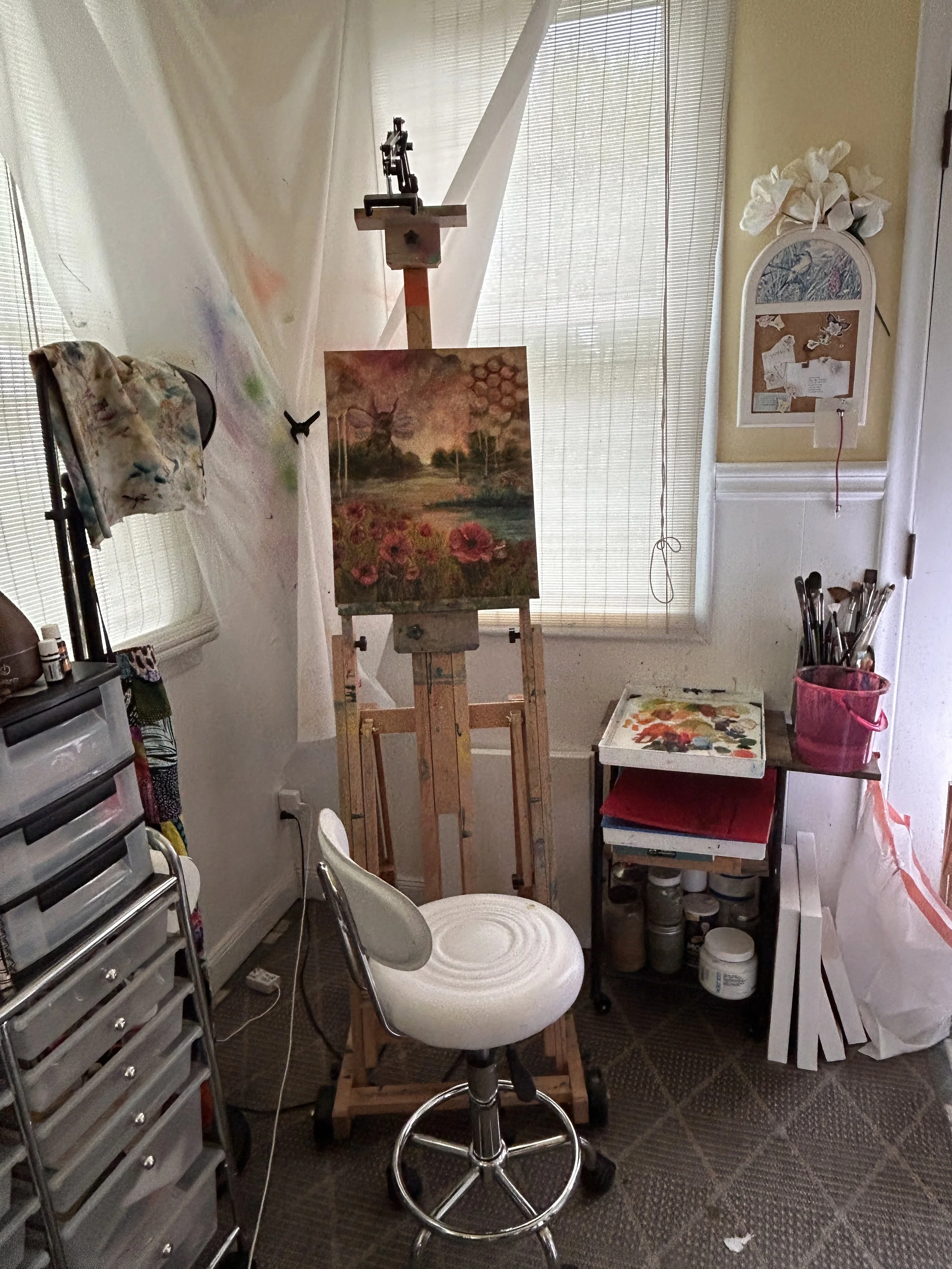
I have windows on three walls, a view of my garden in the summer, andits magically moody in the rain. A small space heater buys me a little extra time in spring and fall, but once Michigan winter fully settles in, the studio basically shuts down.
So in winter, I migrate to a tiny desk in my bedroom, because that’s the only other available space. And the work shifts with the season. Solvents and ventilation become real issues when you’re also sleeping in the room, so winter turns into oil pastel season. Sketching season. Planning season. The season where I work through ideas and concepts and all the thinking that eventually feeds the paintings once the sunroom wakes back up again.
It’s a limitation that has quietly shaped my process in ways I’ve actually grown to appreciate. Winter is for gathering. Summer is for making.
(I a full studio tour up on YouTube)
I don’t really have a rigid creative ritual, but I have learned I need some kind of transition into painting mode. If I walk into the studio distracted or mentally scattered, the painting usually knows immediately.
So there’s a loose sequence that tends to happen.
Coffee or tea first. Always.Then the diffuser goes on. Something about scent tells my brain we’re shifting gears now.And then music.
Honestly, the music might be the most important part.
What I listen to changes depending on the piece or the season of the work, but lately I’ve been deep in a Lindsey Stirling phase. If you’ve never heard her, she’s a violinist who mixes classical strings with electronic production. Completely instrumental, but definitely not background music. It’s layered and cinematic and full of movement without my brain getting hooked on lyrics every thirty seconds.
It feels right for this collection especially. Luminous. Atmospheric. A little unexpected. More complex than it looks at first glance.
My Process
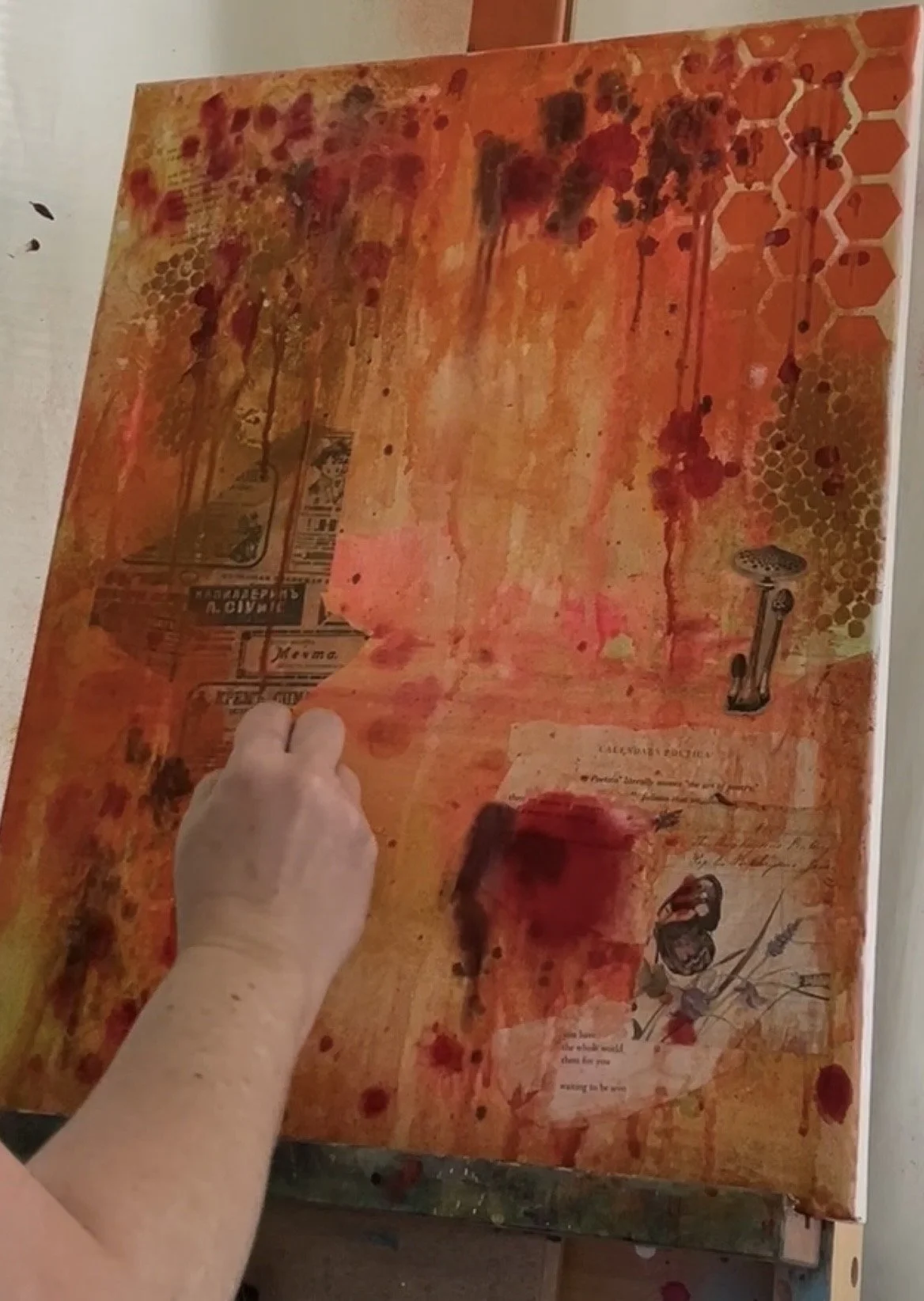
My process is always the same and I start by making a mess.
Before anything intentional happens, I need to kill the white. I cover the entire surface with color as fast as possible because blank canvases have a way of making every mark feel weirdly precious and permanent. Once the surface is already messy, the pressure disappears.
I think loosely about the palette I’m heading toward, then start reaching for anything that gets color and texture down quickly. Spray paint. Collage. Ink. Texture paste. Markers. Acrylic. Whatever works. Sometimes I have composition in mind already and am mapping large, generic shapes. Sometimes I wait to see what I can pull out of this layer and let the painting kind of tell me what it wants to be.
Either way, nothing is precious at this stage.
The goal is coverage, movement, texture, and a foundation the rest of the painting can push and pull against later.
From there, I start building through layers of acrylics. This is where the landscape slowly starts emerging from the chaos underneath. Acrylics let me work quickly, cover mistakes, shift directions, glaze, scrape things back, change my mind repeatedly. Which I do. Frequently.
I usually get a painting about three quarters finished in acrylics before switching to oils.
And honestly, that’s the moment everything changes.
Oil paint has a richness and luminosity acrylics just can’t replicate. It’s slower and moodier and dramatically less cooperative, but the depth is worth it. The final oil layers are where the atmosphere really starts showing up. The glow. The softness. The light sitting on top of the surface instead of just inside it.
If acrylics are the structure of the painting, oils are the atmosphere.
For this collection especially, that matters a lot. These landscapes are carrying themes of promise, provision, abundance, golden light, all these things that need warmth and depth to feel believable. The honey gold glow I keep chasing doesn’t happen in acrylic alone. It needs those final oil layers catching the light in a completely different way.
Working in a small space has also taught me something I honestly didn’t expect.
Limitations make you better.
I love experimenting. New materials are basically my toxic trait. Left unsupervised in an art supply store, I become financially irresponsible almost immediately.
But the sunroom keeps me honest because there simply isn’t room for everything.
So if a material or tool isn’t earning its place, it goes. No hoarding weird supplies for imaginary future projects. No keeping things purely because I spent money on them. Everything I own has to actually work.
And weirdly, that consistency has probably helped my work more than unlimited options ever would have.
When you work with the same materials over and over, you stop obsessing over the tools and start learning what they’re actually capable of. You develop a relationship with them. You learn how they behave. How far you can push them. What kinds of marks they naturally want to make.
That relationship starts showing up in the work eventually.
I think that’s where voice comes from more than people realize.
Not from constantly reinventing yourself, but from going deeper with what’s already in your hands.
And honestly, the light through those three walls of windows is extraordinary.